

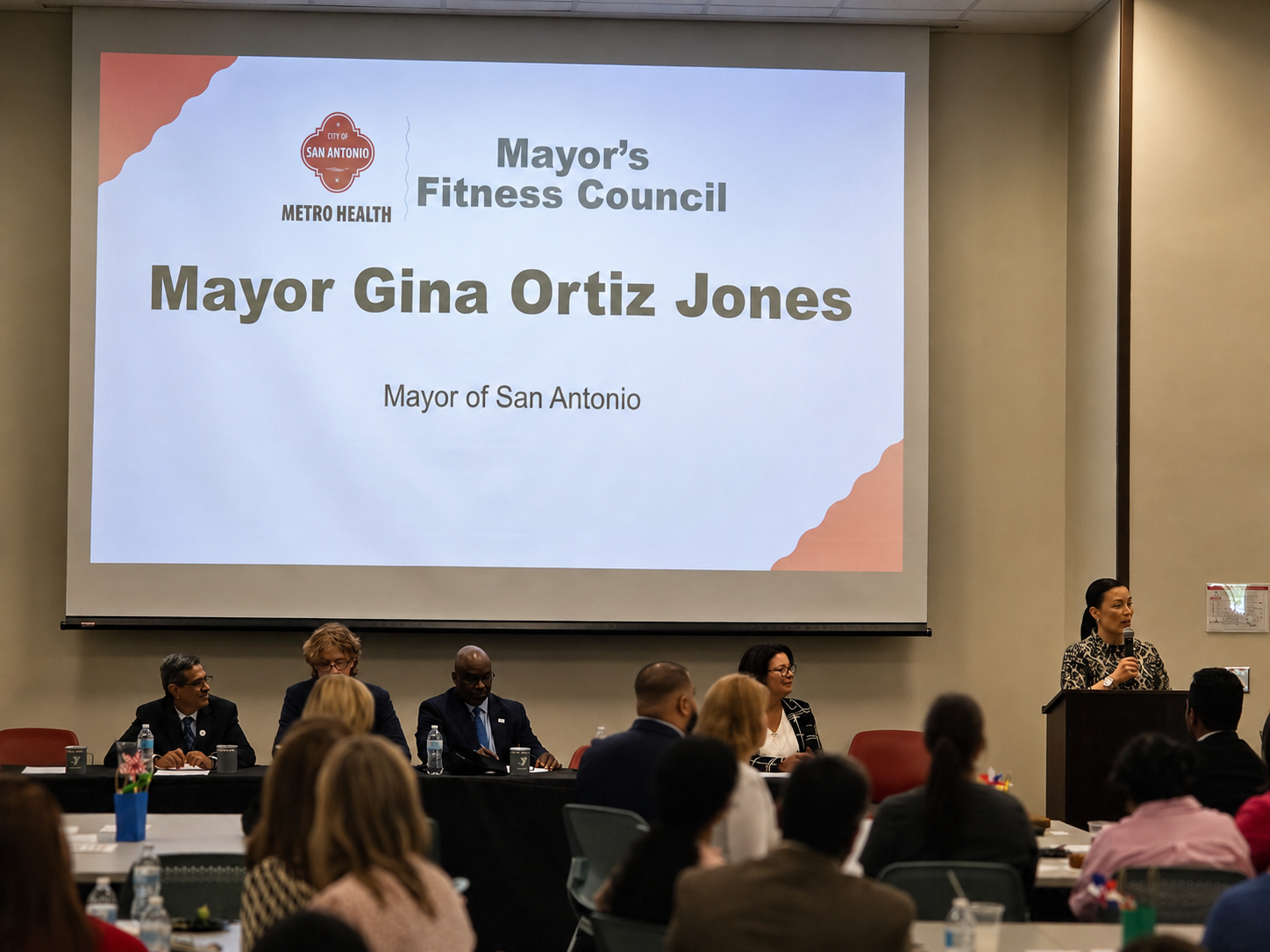
I recently attended the San Antonio Mayor’s Fitness Council Award presentation, where the city was recognized for its work in the Healthier Texas Community Challenge.
That moment deserves applause.
San Antonio has people inside and alongside government who are doing the hard work of helping residents move more, eat better, and live healthier lives. The Mayor’s Fitness Council exists for that reason: to connect residents to emotional well-being, physical activity, and healthy eating opportunities across the city.
But celebration should not require denial.
San Antonio’s health reality is not all sunshine. The city’s own public-health work points to serious burdens around diabetes, obesity, chronic disease, and unequal outcomes.
Bexar County’s diabetes hospitalization and mortality burden remains higher than Texas and national benchmarks in key areas. Other local health planning data shows that fewer than half of Bexar County adults meet the 150-minute aerobic activity benchmark, while more than 70% are categorized as overweight or obese.
That tension matters.
The Gap Is Not Effort
The gap is coordination, measurement, and sustained activation.
SA Forward was built because Metro Health sees the same thing: health is shaped by access, data, food security, equity, mental resilience, and the conditions people live in every day.
When city priorities, local fitness operators, public-health measurement, and behavior-change systems work together, fitness can become more than access.
It can become activation.
Fitness as Infrastructure
That is why I’ve been paying more attention to other areas, including the Health & Fitness Association’s advocacy work for commercial fitness clubs and human performance programs like the Army’s Holistic Health and Fitness program.
I started to see some version of the same question show up everywhere:
Is fitness a benefit, a healthcare tool, or infrastructure for performance?
The Health & Fitness Association’s Fly-In brings fitness leaders to Washington, D.C. to meet with policymakers and advocate for the industry’s role in prevention, healthcare, business policy, and national readiness.
This year’s conversation made something clear: fitness is increasingly being positioned as health infrastructure.
Not just recreation.
Not just consumer wellness.
Infrastructure for prevention, lower healthcare costs, workforce reliability, and even military readiness.
The Human Performance Question
In the Senate’s FY27 NDAA language, Section 766 would establish a Warfighter Performance Optimization Initiative, with Total Force Fitness as a foundational framework for readiness, resilience, and performance.
Some in the human performance community, including Alex Morrow, have raised concerns that placing strategic control under Health Affairs may pull performance too far into a medical incentive structure instead of an operational one.
There is a strong case for placing human performance under Health Affairs.
These programs touch injury prevention, rehabilitation, nutrition, sleep, behavioral health, medical readiness, and long-term force health. Housing them closer to the medical enterprise could improve clinical integration, strengthen evidence requirements, and connect performance teams more directly to prevention and recovery outcomes.
There is also a strong case for keeping human performance operational, as Alex argues.
The purpose is not simply to reduce medical burden. It is to improve readiness, resilience, and mission performance. Operational ownership can keep the focus on preparing people to perform before they break.
Where Groe Fits
I don’t know enough to say which argument is more valid on the federal side.
And I definitely don’t know enough to guess what the equivalent of those arguments should be on the commercial side.
But I know this:
Groe will be there.
At the leading edge across commercial and governmental efforts, building systems that verify training adherence, activate local gyms, connect public-health goals to daily behavior, and turn effort into measurable progress.
A healthier population is not only a public-health outcome.
It is economic development, workforce reliability, readiness, and dignity.
And if we build it right, we can GroeFit Together.